
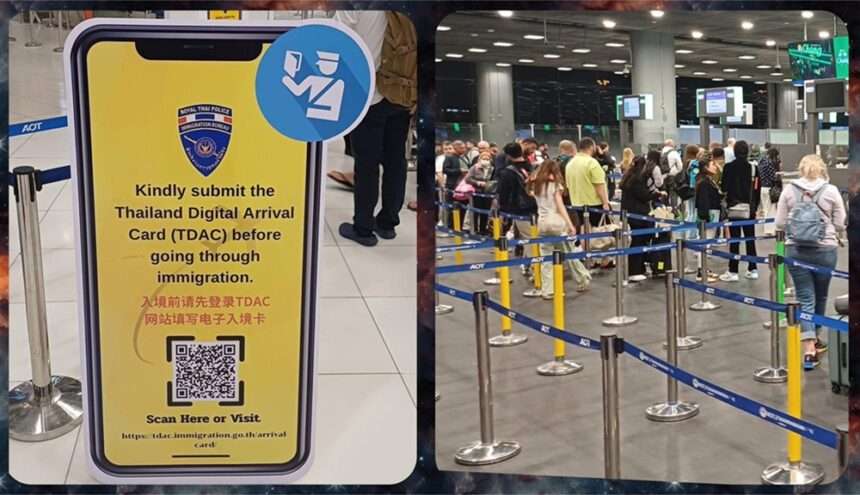
Thailand is entering a new era of immigration policy, blending streamlined digital entry with tougher enforcement against visa misuse. With upgraded systems and new visa pathways introduced across 2025 and 2026, the government aims to attract genuine visitors and long-stay contributors while curbing loopholes long used for unofficial stays and underground work.
A cornerstone of the overhaul is the mandatory Thailand Digital Arrival Card (TDAC), which officially replaced the paper TM6 form on May 1, 2025. All foreign arrivals must now complete the online form before landing, a move designed to minimise airport congestion and modernise border processing. The TDAC’s data is transmitted instantly to agencies such as the Department of Disease Control and the Immigration Bureau, improving both security and public-health monitoring.
The digital upgrades run alongside the global expansion of Thailand’s official e-Visa system. From January 1, 2025, travellers worldwide have been able to apply entirely online for major visa types, including tourist, business, and the increasingly popular Destination Thailand Visa (DTV). This shift supports the government’s Thailand 4.0 vision by reducing paperwork and offering faster, more efficient screening for travellers.
Long-stay visitors now have clearer, more flexible options, with the DTV emerging as one of Thailand’s most notable additions. Often described as a “digital nomad visa,” the DTV is designed for remote workers, “workcation” travellers, and those taking part in cultural or creative activities such as cooking courses, Muay Thai training, and music events. Valid for five years, it allows multiple entries, with each stay lasting up to 180 days and extendable for another 180 days for a 1,900-baht fee. Applicants must show a minimum of 500,000 baht in funds and must not take local jobs, but can legally work online for overseas clients.
Fees for the DTV vary by embassy—typically between 8,856 and 36,826 baht—due to administrative differences and currency fluctuations. Its structure provides long-term flexibility rarely offered in previous visa schemes.
Meanwhile, Thailand continues to maintain its visa-exemption program for 93 countries, allowing 60-day entry with the option of a 30-day extension. For short-term vacationers, this remains the easiest path. However, authorities are now firmly closing the door on repeated “visa runs,” where travellers exit and re-enter Thailand to extend their stay indefinitely.
Immigration officials confirmed in late 2025 that travellers arriving on their third consecutive visa-exempt entry should expect closer scrutiny. Officers are instructed to assess travel patterns, financial proof, and intentions, particularly when the traveller’s previous stays were long. Genuine tourists typically stay about two weeks, officials say, whereas serial visa runners often rely on continuous tourist entries while conducting undeclared work or business.
To add clarity for lawful long-stay residents, Thailand also introduced new tax rules in 2025. Anyone staying 180 days or more in a calendar year is considered a tax resident, meaning foreign income remitted into Thailand may be taxable. Remote workers and expatriates are encouraged to seek professional advice regarding their financial planning.
Altogether, the reforms mark a strategic shift in Thai immigration. By offering clearer legal pathways, digital convenience, and stronger oversight, Thailand signals that well-intentioned visitors remain welcome—while unregulated long-term stays face more obstacles than ever.